An Interview with Svitlana Biedarieva | Disentangling Russia’s Colonial Legacy in Ukraine
Oleksandr Pankieiev: I want to begin by asking about the concept of ambicoloniality that you coined and introduced into scholarly discourse. It is a compelling and thought-provoking idea. Can you explain what you mean by ambicoloniality, and how this concept differs from other analytical frameworks, such as postcolonial and decolonial approaches?
Svitlana Biedarieva: I introduced this term in my book Ambicoloniality and War: The Ukrainian–Russian Case. In developing the concept, I aimed to address what I saw as a persistent gap between postcolonial and decolonial theories—above all, their limited capacity to account for the specificities of the Ukrainian case. The notion of ambicoloniality builds upon insights from postcolonial and decolonial theorists. For example, I engage concepts such as postcolonial ambivalence and self-colonization. I also draw on the decolonial idea of extended or enduringcoloniality, understood as a power structure that continues to reproduce the logic of colonialism even after formal colonial rule has ended.
Yet even within the postcolonial and decolonial theoretical models, Ukraine does not occupy a clearly defined analytical space. It does not entirely fit the case studies typically examined by either postcolonial or decolonial theorists, for different reasons. Ukraine exhibits several characteristics that set it apart—chiefly its cultural proximity to Russia, which is conditioned by its contiguous geographic proximity and shared border.
When I speak about ambicoloniality, I am trying to capture a specific logic of exchange and the type of domination produced through that exchange, which are largely sustained by the existence of the Russian-Ukrainian border. Another factor is what I describe as Russia’s polymorphous coloniality in relation to Ukraine and the shifting ways that Russia positions Ukraine within its own worldview—including the tendency to cast Ukraine as part of a hostile collective imaginary West.
These nuances and particular characteristics make it challenging to locate Ukraine within either a conventional postcolonial or decolonial framework. The ambicolonial theory I propose is grounded in cultural proximity, sustained by institutional and infrastructural networks—since culture is always supported by material and organizational forms—as well as in geographical proximity and the polymorphous coloniality of a former colonizer and aspiring neo-colonizer.
The term ambicoloniality denotes Russia’s sustained attachment to the Ukrainian cultural field and its long-standing compulsion to appropriate elements of Ukrainian culture and present them as its own. At the same time, it has throughout history involved incorporating Ukrainian cultural forms in ways that reshape Russian culture and Russia’s vision of itself, both regionally and globally. In this sense, ambicoloniality conceptualizes the dynamic in which one country becomes fixated on another country’s symbolic and cultural strengths. This obsession can lead first to appropriation and then to violent transgression, aimed at maintaining a connection to the object of obsession and colonial desire.
This focus on colonial desire and the affective dimensions of colonialism is something I draw from postcolonial theory. For example, Leela Gandhi’s Affective Communities was very useful, particularly for tracing how colonial desire develops. I also turn to psychoanalysis—especially Lacanian psychoanalysis—to conceptualize how this colonial fixation first emerges and then unfolds under neocolonial conditions in the context of wartime violence. Here, I use the Lacanian notion of jouissance—a deadly or destructive enjoyment in which desire becomes harmful both to the object of desire (because it ultimately aims to destroy the object) and to the subject of desire (because the attempt to enact that desire is simultaneously self-destructive). In this context, we can speak about ongoing neocolonial actions. This is, more or less, the framework I develop in my book.
I define ambicoloniality as a continuous condition that envelops Ukraine’s three centuries of historical colonialism; the period of anti-colonial resistance following the formal dissolution of that colonial arrangement in 1991, with the collapse of the Soviet Union and the beginning of Ukrainian independence; and finally, the postcolonial condition and decolonial situation. I propose that ambicoloniality persists across all of these stages. What changes from one stage to the next is the manner of this exchange, which is specific to each period, while the reality of the shared border never disappears.
Pankieiev: How do you think this concept helps us to understand Russia’s war against Ukraine? When we introduce ambicoloniality into an analysis of warfare, including not only conventional military conflict but also cultural warfare, what becomes visible? If we look at the current war through the lens of ambicoloniality, what does it allow us to see about what Russia is doing in Ukraine right now?
Biedarieva: I distinguish four stages of ambicoloniality, if understood as a condition, addressing it from a vantage point of ambicolonial theory as a set of analytical methods. Firstly, there is a filtering process in which mutual symbolic and cultural influences are mediated across the border—that is, both the geographic and epistemic borders. There is not only an exchange of cultural elements but also an epistemological exchange.
The second stage is appropriation. Here, the country occupying the position of colonizer—the dominant political and economic position within the relationship—attempts to appropriate cultural achievements and phenomena from the subaltern country in that exchange. Through appropriation, the colonizer modifies its own cultural and public fields, with lasting historical and political effects, because it is impossible to separate culture from society and social processes.
The third stage is affection, or obsession, which I discuss in my chapter on colonial desire. This is where an image of the Other is created through defining the Other’s distinctive characteristics, but also through projecting imagined—often utopian—qualities onto that Other in ways that make it belong to the colonizer’s field of influence.
Finally, especially when the formerly colonized side begins to detach or disentangle itself, we see the stage of transgression. This stage aims to maintain the existing power structure. In the case of Russia, transgression culminated in its violent invasion of Ukraine, which is an attempt to sustain power through force by waging neocolonial war.
In my book, I draw on Hannah Arendt, especially her essay “On Violence,” where she discusses the relationship between power and violence, arguing that violence emerges when power is being lost. In this sense, violence manifests as a symptom of powerlessness. When power recedes, a void opens up that is filled by violence, which then tries—irrationally and destructively—to preserve an existing power structure. This is how I understand Russia’s war against Ukraine.
In terms of ambicoloniality, by violently attempting to maintain the crumbling symbolic power structure, Russia’s attack is paradoxical in that it targets the ambicolonial condition itself—seeking, in effect, to destroy this historically produced relation of exchange. Yet at the same time, Russia’s violence also aims to preserve ambicoloniality on a radically new footing. It is compelled to hold the entire structure together through coercion, even as Ukraine, through processes of decolonization, is actively attempting to disentangle itself from that relationship.
Pankieiev: We are talking about the entanglement of culture and history, and in this process, there are two actors: the colonizer and the colonized. However, because of this proximity—cultural, historical, and geographical—observers outside the region sometimes do not see it as an entanglement at all. Instead, they perceive it as an undifferentiated whole. That perception makes the relationship very difficult to analyze, and it helps explain why concepts like coloniality and postcoloniality often fail to capture the specific conditions of Ukraine. In your book, you suggest that this entanglement is extremely difficult to overcome, perhaps almost impossible. Could you speak about why disentanglement is so difficult?
Biedarieva: Geographic proximity, in many cases, conditions cultural proximity. Because of this, it is very difficult to fully divide or split the hybridity that has formed across cultural fields, not only in Ukraine but also in Russia. In my view, the two countries are now moving through different conditions. I argue that Russia persists in a largely postcolonial condition, oriented retrospectively toward colonial patterns of the past and attempting to recreate them in the present. By contrast, Ukraine has reached a decolonial situation, focused on its own agency in epistemic production in a way that detaches from the trauma and contested memory of the past in order to focus on the unfolding present. Along these divergent paths, an epistemic gap emerges that widens as Russia’s war becomes more violent.
Given that geographic proximity cannot be eliminated, it is especially important to build an independent epistemic field that connects different cultural agents and parts of Ukrainian society through exchange and dialogue across the territory of Ukraine. This is what I define as internal hybridity. As I outline in the book, internal hybridity functions as a substitute for postcolonial hybridity. When postcolonial hybridity dissolves as part of the inevitable decolonial process and certain cultural elements are expelled from the symbolic field (particularly in Ukraine), a void emerges that needs to be filled. The internal exchange that develops in response underpins internal hybridity.
Paradoxically, Ukrainians’ war-related displacement has contributed to strengthening this internal hybridity. When artists and cultural producers from the east and south in those territories currently occupied by Russia were forced to relocate, many moved to western and central regions of Ukraine and were received there in 2022. Through artistic residencies and support from cultural organizations, they were able to present their work, collaborate with local communities, and develop new languages to describe the situation. This produced a new kind of dialogue.
Culture is only one example of how society functions, but I believe it is representative of broader processes. It shows how society moves and what connections are established. Internal hybridity describes this new dialogue and the emerging fusions of cultural elements. At the same time, it becomes not purely internal. Through solidarity and resistance, these processes extend beyond Ukraine’s borders through Ukrainian communities abroad and through new networks and infrastructures. In this way, we can speak about an ongoing replacement of older epistemic structures with new ones.
Pankieiev: You touched on propaganda and its danger as a hindrance to overcoming entanglement. Russia uses propaganda not only as a tool of attack but also to blur or destroy the lines between the two cultures. Could you address propaganda as part of modern warfare?
Biedarieva: When I speak about Russia’s polymorphous coloniality, I am highlighting several features of Russian propaganda as a discursive practice. One example I mentioned earlier is Russia’s repeated references to “the West,” or the “collective West,” and to Ukraine’s role within it and how this “collective West” then becomes part of Russia’s own imaginary West. Of course, this is conditioned by the legacy of the Cold War, and contemporary Russia ably and purposefully reuses elements from twentieth-century history, including stoking the polarization of the twentieth-century global order.
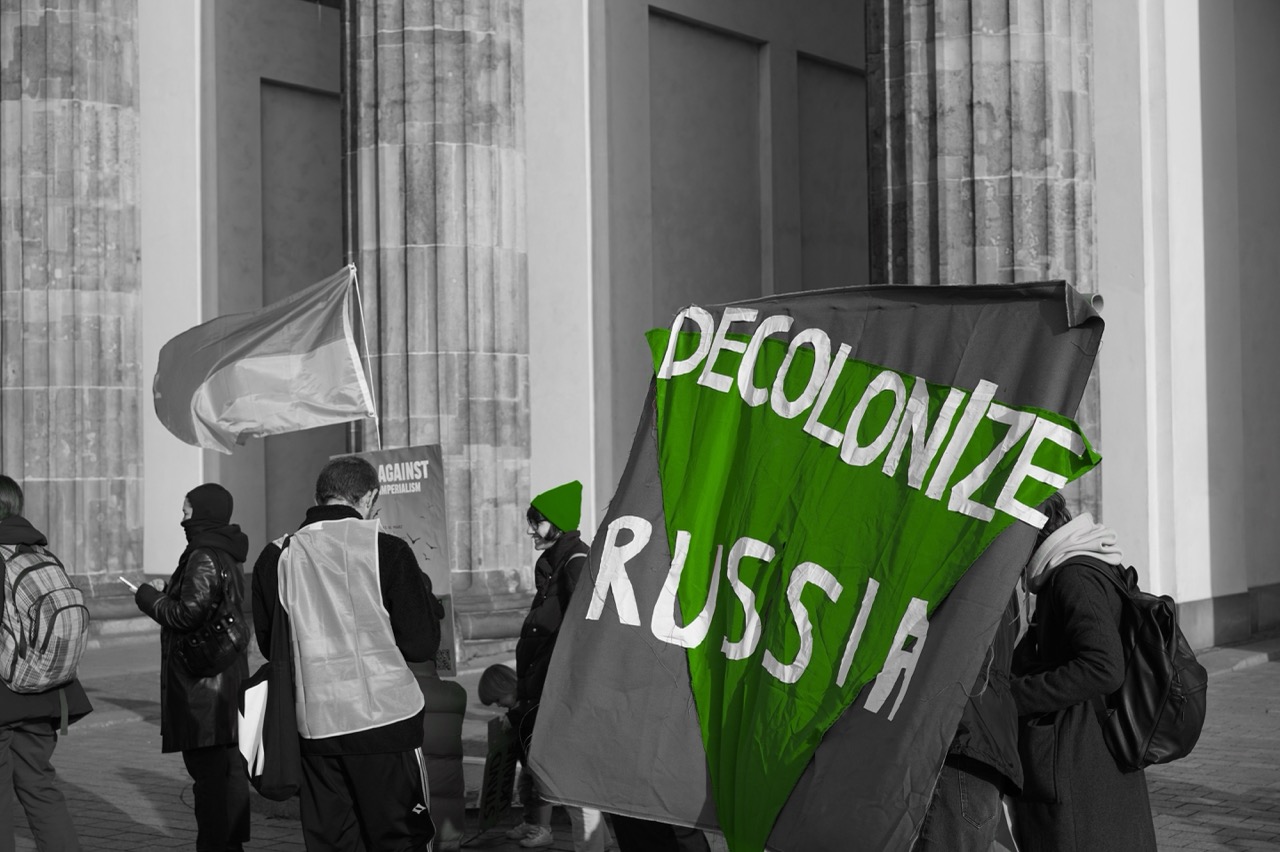
At the same time, Russia frequently adopts a position of victimhood and frames its actions as a kind of “decolonization,” even as this rhetoric echoes its presumably anti-imperialist posturing from the twentieth century. In this context, decolonial theory’s critique of European or Western-centric colonialism can be rhetorically useful for the Russian case. In certain contexts, Russia deliberately presents itself as not European but Eurasian, therefore occupying a weaker position within the global order. Here, I find Madina Tlostanova’s idea of the second-rate empire relevant. She distinguishes between “first-rate” European empires and “second-rate” empires such as the Russian and Ottoman, which developed in relation to those European centers.
Russia adroitly shifts between the positions of victim and superpower—which are, of course, binary oppositions—but on closer inspection, the “superpower” claim is difficult to sustain. However, Russia’s polymorphous coloniality creates a particular opportunity for an expanded propaganda space. This is something unique that Ukraine has to contend with, because if we think about other contemporary examples of colonialism and neocolonialism, we can find different discursive ways to interpret them, but we don’t find the same type of ever-changing discourse that is never fixed.
This leads us back to the notion of decolonization. Some of my colleagues have recently criticized the term for being insufficiently precise. For example, if the well-known decolonial scholar Walter Mignolo can deploy it to rationalize Russian aggression as “epistemic disobedience,” then could it not also be directly deployed by Russia for propagandistic purposes? If so, what does that say about the validity of the concept in general?
This takes me beyond what I set out in my book, where I distinguish between different types of decolonization in Ukraine across the postcolonial condition and the decolonial situation and develop a typology of decolonizing practices. More broadly speaking, “decolonization,” as it circulates across multiple fields, can function as an empty signifier. In Saussurean semiology, we understand the sign as a relation between the signifier and the signified. However, there are situations in which meanings can change in unpredictable and random ways. This phenomenon was described by Roland Barthes within the structuralist approach and later developed by Ernesto Laclau in his post-Marxist political theory through the concept of the empty signifier. In this way, decolonization can serve as an example of an empty signifier. I prefer to speak about decolonial processes that reshape how meaning is produced in society and how culture is shaped, and how cultural, social, and political structures are reproduced. For me, this is the most concrete and, at the same time, nuanced way to define and interpret decolonization.
Pankieiev: In your book, you pose two related questions about victory: Does decolonial release condition victory, or is this relationship reciprocal? And whether it is correct to link victory to decolonial release at all? Could you elaborate on how you understand “victory” in relation to decoloniality? What does victory mean in the context of Russia’s current war against Ukraine?
Biedarieva: Decolonial release is another notion that I coined. Decolonial scholars widely use the term decoloniality, often treating it as a kind of utopian horizon toward which formerly colonized cultures should aspire. At the same time, they acknowledge that it is impossible to entirely detach from colonial influence, since we cannot rewrite history. And, of course, we also cannot change geography, especially in cases where the former colonizer remains in the immediate vicinity of the formerly colonized.
Decoloniality can remain, then, a somewhat abstract notion that describes an idealized condition of society able to exercise full agency and assume independent responsibility for its actions without continually orienting itself toward the former metropolis. I propose a more concrete notion with decolonial release, defined as a point in time at which decolonial processes reach a decisive threshold. It is a moment when there is a complete split that dissolves, to a certain degree, postcolonial ambivalence and postcolonial hybridity, while fostering what, as above, I call internal hybridity. It also encourages what I describe as syncretic polarization, in which two distinct sets of cultural elements associated with the formerly colonized and the colonizer become polarized.
At the same time, it is clear that this is utopian in its own way and difficult to imagine such a condition being fully realized. For that reason, rather than locating decolonial release entirely in the domain of hybridity and dehybridization, I prefer to frame it in terms of tangible capacities such as the capacity for epistemic production, the capacity to pursue epistemic justice, and the capacity to achieve international visibility for Ukraine and Ukrainian culture within global processes and broader transnational fields. This is where I see decolonial release as something that can be meaningfully articulated.
How does this relate to victory? Decolonial release is surely a necessary precondition of victory. However, I left the final chapter of my book somewhat intentionally open, because this conversation needs to continue. I also hope that my colleagues will adapt and modify this method to extend the research into different regions within Ukraine, different historical periods, or the broader post-Soviet space. Where the necessary conditions of cultural proximity, geographic proximity, and polymorphous coloniality persist, I believe this ambicolonial model can be applied, with appropriate modifications. It is a flexible model, and my hope is that it can help to explain how culture represents societal processes and how decolonial processes represent release from colonial influences.